Beyond the Chatbot—The Rise of 'Middleware' Agents
Beyond the Chatbot—The Rise of 'Middleware' Agents
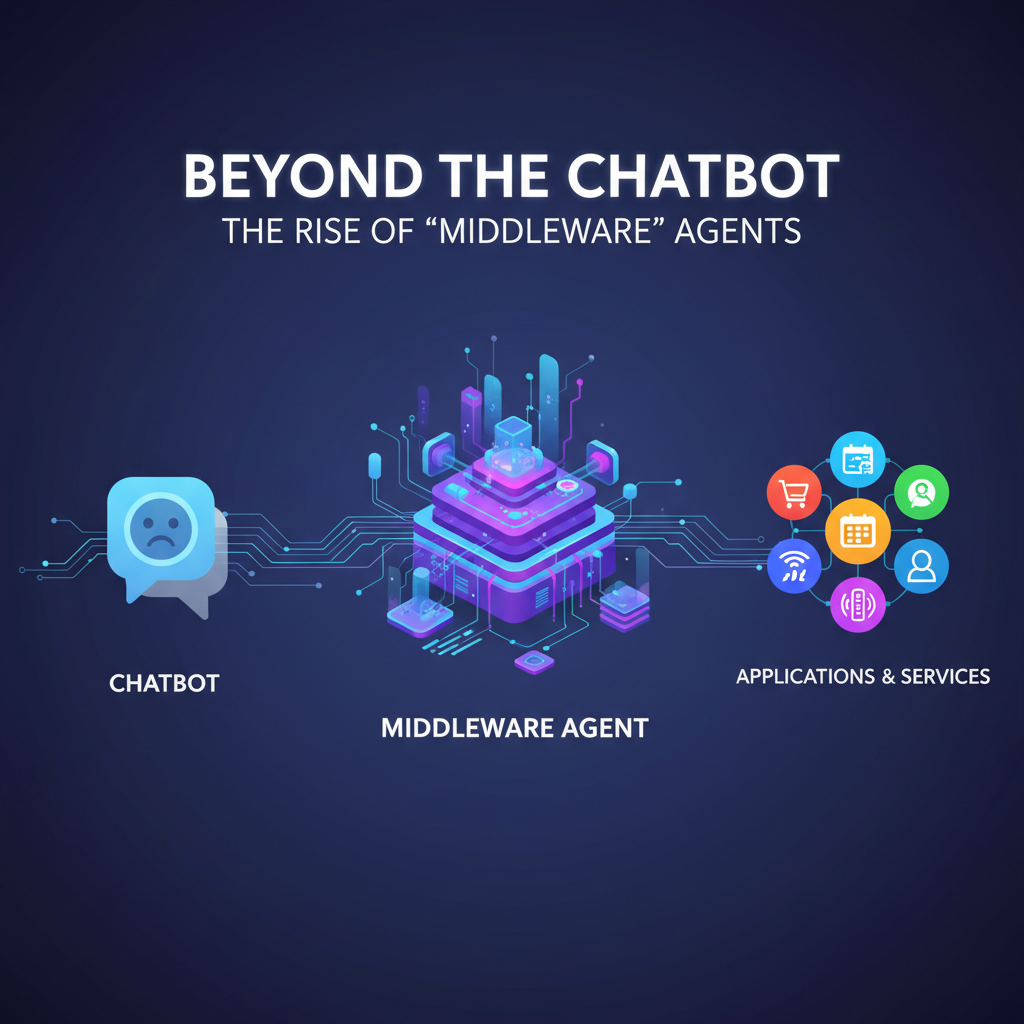
The digital landscape is rapidly evolving, and with it, our understanding of artificial intelligence. For years, the term "AI" in public consciousness often conjured images of chatbots—conversational interfaces designed to answer questions or perform simple tasks. While indispensable, these chatbots represent only the initial frontier. Today, we're witnessing the ascent of a more sophisticated form of AI: the "middleware" agent. These aren't just intelligent conversationalists; they are autonomous systems capable of orchestrating complex workflows, connecting disparate tools, and fundamentally transforming how businesses operate.
From Chatbots to Agentic AI
To appreciate the power of middleware agents, it's crucial to understand their evolution from their simpler predecessors. A chatbot is primarily a software application designed to simulate human conversation through text or voice. Early chatbots were rule-based, offering predefined responses. The advent of natural language processing (NLP) and machine learning led to more contextually aware chatbots, capable of understanding intent and offering more personalized interactions. These are often seen in customer service, providing immediate support for frequently asked questions.
However, AI agents represent a significant leap forward. According to IBM, an AI agent is "a system that autonomously performs tasks by designing workflows with available tools." This definition highlights their key differentiators:
- Autonomy: Agents can initiate actions and make decisions without constant human oversight.
- Task Performance: Their purpose extends beyond conversation to actively accomplishing goals.
- Tool Integration: They don't just "talk" about tasks; they interact with and leverage other software, APIs, and databases.
These advanced "virtual agents" are a further evolution of AI chatbot software, moving from reactive conversation to proactive task execution What Is a Chatbot? | IBM.
The Middleware Magic of AI Agents
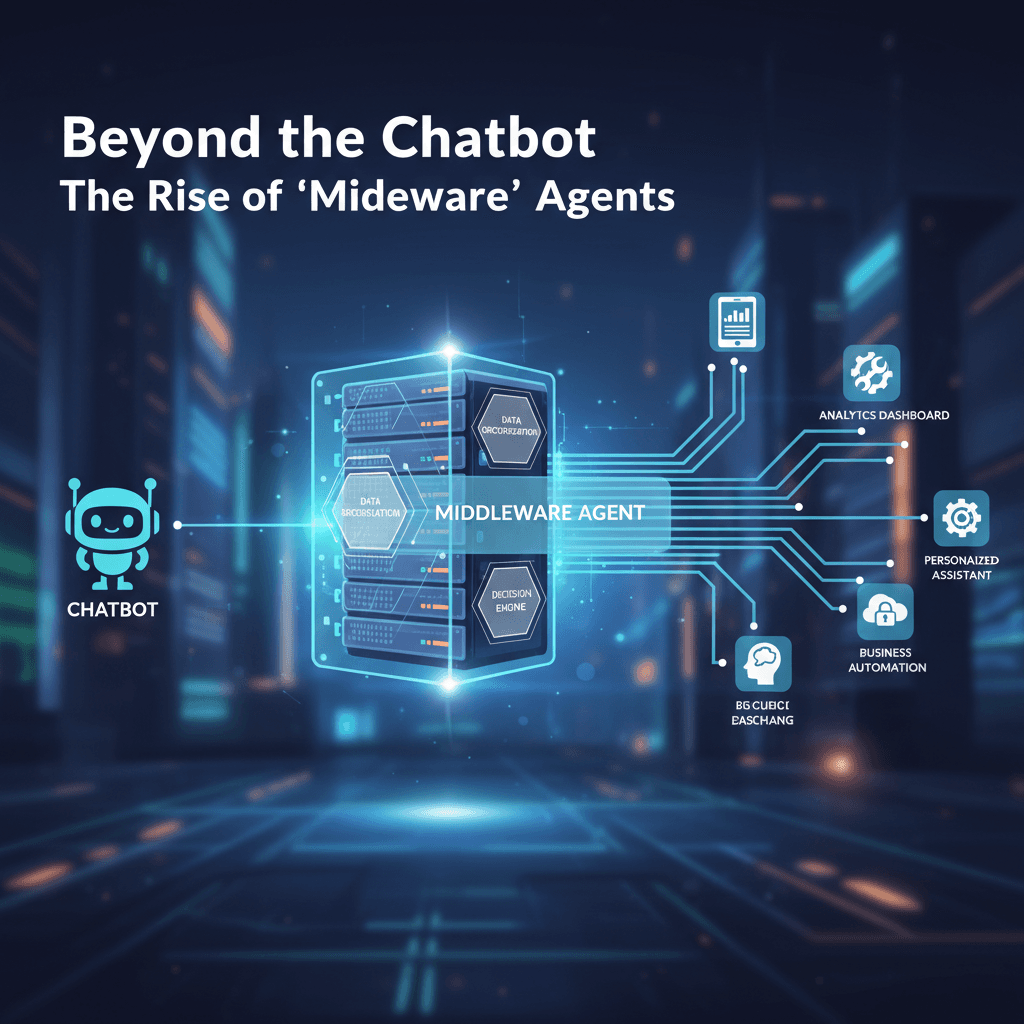
The term "middleware" perfectly captures the essence of these new AI agents. Much like traditional middleware historically facilitated communication between different applications, AI agents act as an intelligent intermediary. They sit between users or higher-level systems and the diverse array of tools needed to execute a task, orchestrating the entire process.
Consider how an agent might function:
- Connecting Disparate Systems: An AI agent can pull data from a CRM, analyze it with a specialized analytics tool, and then initiate an action in an email marketing platform—all seamlessly. This mirrors how tools like Microsoft Power Automate are used as "middleware for some APIs that have a non-standard interface" What are some great examples of Power Automate application at ....
- Designing Workflows: Rather than being programmed for a fixed sequence of steps, an agent can dynamically determine the best tools and order of operations to achieve a given goal.
- Context Engineering: Managing the right amount of information—not too much to cause errors, not too little to limit capabilities—is critical. Frameworks like LangChain acknowledge this delicate balance in "context engineering" for agents Context engineering in agents - Docs by LangChain. The middleware agent intelligently handles this flow of context across various tools.
Real-World Applications and Enterprise Impact
The rise of middleware agents is not merely theoretical; it's actively reshaping industries and operational models.
Customer Service Transformation: Beyond answering FAQs, AI agents are revolutionizing customer service by enabling greater personalization and proactive engagement. IBM's insights reveal that 66% of global customer service managers optimize AI with generative AI to boost personalization. Future systems will leverage agents not just to recall past interactions but to anticipate needs and offer solutions proactively. Telecommunications companies, for instance, are already deploying agents far beyond simple customer service interactions The agentic organization: A new operating model for AI | McKinsey.
E-commerce Scalability: Platforms like Mirakl are leveraging AI to power scalable e-commerce solutions, enabling businesses to adopt robust marketplace and dropship models. AI agents can automate inventory management, supplier interactions, personalized recommendations, and order fulfillment across complex ecosystems.
The Agentic Organization: McKinsey posits that the "agentic organization" represents a new operating model for the AI era. In this paradigm, AI agents become integral to strategic operations, not just tactical support, driving economic growth by optimizing service employment and efficiency.
Challenges and the Path Forward
While the potential of middleware agents is immense, their implementation comes with its own set of complexities and considerations.
- Technical Hurdles: Building robust AI agents is more challenging than developing simple chatbots or RAG (Retrieval-Augmented Generation) systems. Developers are constantly navigating the nuances of agent frameworks, and some are even moving beyond earlier tools due to limitations in building advanced agents Why we no longer use LangChain for building our AI agents.
- Control and Governance: As agents gain more autonomy and access to critical enterprise systems, establishing robust "controls and governance" becomes paramount. This complex new digital technology "naturally increases the hazards" if not managed carefully How Agentic AI is Transforming Enterprise Platforms | BCG.
- Expectation Management: The hype surrounding AI agents can sometimes outpace current capabilities. As one Reddit discussion points out, there's a "truth no one talks about" regarding the gap between visionary concepts and the practical realities of current implementations AI Agents truth no one talks about : r/AI_Agents - Reddit.
The journey towards fully realized, highly capable middleware agents is ongoing. It requires continuous innovation in AI research, thoughtful system design, and strong ethical frameworks to ensure these powerful tools are developed and deployed responsibly.
The Chatbot is Dead. Long Live the Agent.
The era of the simple, reactive chatbot is receding. In its place, a new class of intelligent middleware is emerging—sophisticated AI agents that don't just talk; they act. These are autonomous orchestrators capable of connecting disparate tools, designing complex workflows, and executing multi-step tasks across the enterprise with minimal human intervention.
From supercharging e-commerce logistics to redefining entire organizational operating models, middleware agents are the invisible engine driving the 2026 digital revolution. However, the path from "experimental bot" to "autonomous enterprise" is paved with technical complexity, legal gray areas, and ethical hurdles.
Bridging the Gap with SoftServedWeb Embracing this potential requires more than just a subscription to an LLM; it requires an architect. At SoftServedWeb, we specialize in building the bridge between raw AI models and governed, secure business workflows. We don't just build agents that answer questions—we build agentic systems that solve business problems.
Ready to move beyond the chat box and start executing? Partner with SoftServedWeb to architect your agentic future.
Sources
- The agentic organization: A new operating model for AI | McKinsey
- AI Agents truth no one talks about : r/AI_Agents - Reddit
- What Are AI Agents? | IBM
- What are some great examples of Power Automate application at ...
- What Is a Chatbot? | IBM
- Mirakl: AI-Powered eCommerce Solutions
- The Future of AI in Customer Service - IBM
- Why we no longer use LangChain for building our AI agents
- How Agentic AI is Transforming Enterprise Platforms | BCG
- Context engineering in agents - Docs by LangChain